Review written by Elizabeth J. Wenger
The Okie Review Series seeks to promote Oklahoma writing by reviewing books by Oklahoma writers.
Jennifer Croft, an International Booker Prize-winning translator and writer, has always been interested in language(s). Her past publications include translations of Spanish and Polish works, an original, best-selling novel The Extinction of Irena Rey (Bloomsbury Publishing, 2024), and a memoir, Homesick (Unnamed Press, 2019), which details Croft’s upbringing in Tulsa and the early blossoming of her love of language.
In her latest book, Notes on Postcards, Croft continues her investigations into language and life, using postcards as a way to open conversations about history, connection, and desire.
Croft’s interest in hybridity was evident in her first memoir, Homesick, which she wrote in third-person, breaking with the conventional “I” of memoirs. Further, she played with the inclusion of images alongside sparse, poetic prose, encouraging readers to question the boundaries of “memoir.”
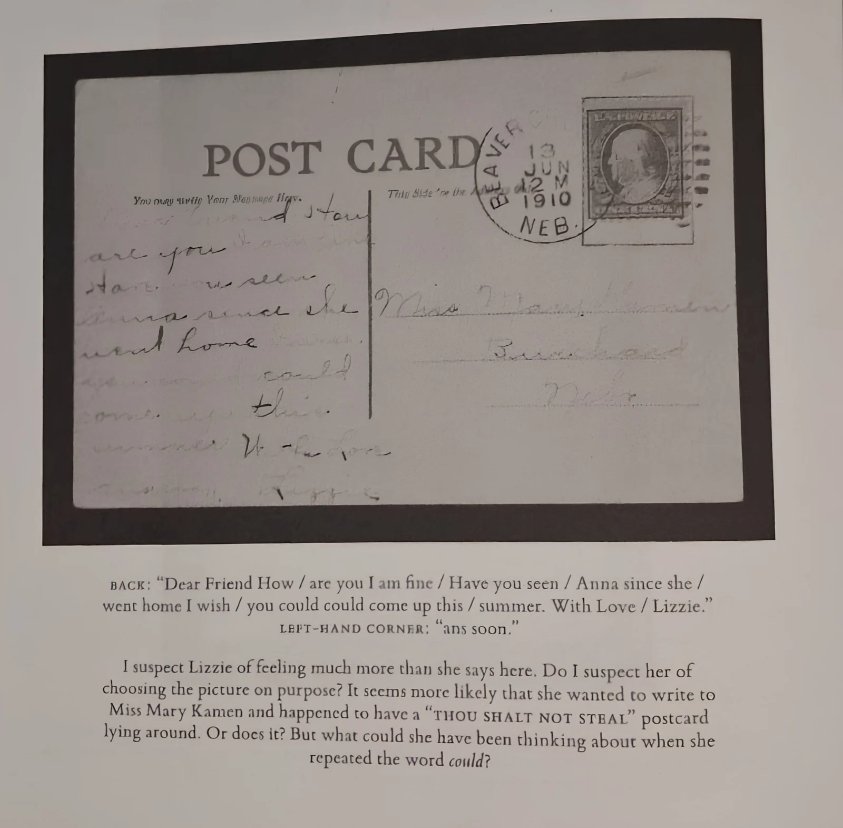
In Notes on Postcards, Croft continues to venture into the borderlands of the genre. To begin with, even the shape of the book (a 7”x7” square) is unconventional. Alongside the more traditionally memoiristic sections of the book, Croft includes a history of the postcard, typographic oddities, and scans of an impressive collection of postcards.
The conversation between image and text that she began with Homesick is at work here, but to greater effect. In Notes on Postcards the images begin to tell a story that compliments and enhances that being told in the prose. In this way, Croft’s latest memoir is a study in ekphrasis as much as it is an exploration of the possibilities of life-writing.
Croft’s attention to language and genre is made clear by her choice to transcribe the handwritten text of the postcards as one would reproduce the lines of a poem. By breaking the messages with the customary slash of poetic quotation, Croft lineates and makes literary what would otherwise be thought of as an everyday form of communication. In this way, a postcard about a funeral becomes an elegy: “Dear Bill, / I am sorry to in / form you of M[...]’s death / She died on the 14th at quarter / past 2 p.m. and will / be buried Wednesday / afternoon try and come / in if convenient / remember Maggie and / S to Mrs. Brown and / family and oblige / S.G.D.”
Well, they say every poem has a line that teaches you how to read it. Croft allows us to see the mechanisms turning behind the page when she writes: “I couldn’t write a book about postcards because there was nowhere to begin. It was like trying to narrate a globe, or a kaleidoscope.” Croft continues, explaining that only during pregnancy did it occur to her “to narrate not the globe, but the action of beholding it (even mid-spin). . . . Not only postcards. But also everything postcards can tell us about being (and making) (and losing) human beings. How to translate, how to move through the minds of others—how to communicate, with and without words.”
Indeed, reading the book feels very much like beholding a spinning globe, not just because Croft takes us everywhere: from Poland to Argentina, Ukraine to Germany, and Tulsa to Arkansas and LA, but also because, through an episodic approach to memoir-writing, Croft is able to capture a stunning array of ideas and moments. In the intermingling of image and word and empty space she is able to translate the self and, yes, communicate “with and without words.”
A result of this form is that the book’s thematic range is as ambitious as its generic one: Notes on Postcards covers language, desire, communication and its limits, motherhood, grief, and literature. Typically, I would be concerned with a book attempting to cover this much ground, but Croft takes an essayistic approach to her topics. She has created a book that reads more like the best kind of braided essay than a straight-forward memoir. It is a text that will be taught in writing workshops for years (this reviewer hopes) as it exemplifies what can happen when form and content mirror one another and elevate a work of literature to a work of art.
Jennifer Croft won a Guggenheim Fellowship for her novel The Extinction of Irena Rey, the William Saroyan International Prize for Writing for her memoir Homesick, and the International Booker Prize for her translation of Nobel laureate Olga Tokarczuk’s Flights. She is also the translator of Federico Falco’s A Perfect Cemetery (Charco Press, 2021), Romina Paula’s August (The Feminist Press at CUNY, 2017), Pedro Mairal’s The Woman from Uruguay (Bloomsbury Publishing, 2021), and Olga Tokarczuk’s The Books of Jacob (Riverhead Books, 2022). She has received the American Academy of Arts and Letters Award in Literature. She lives in Tulsa.
